Following lengthy legislative negotiations, the EU Council has approved the new PPWR (Packaging and Packaging Waste Regulation) measures, aimed at reducing packaging waste and promoting reuse. The rules were officially published in the EU Official Journal on 22 January 2025; however, contrary to some previous reports, they will not come into force until 18 months after publication.
The objective of the new measures is to reduce packaging waste by setting specific targets for reuse, restricting certain types of single-use packaging, and introducing obligations for businesses to minimise packaging. These rules apply to the entire packaging life cycle, including production, distribution, recycling, and disposal of packaging materials.
Packaging recyclability and categories
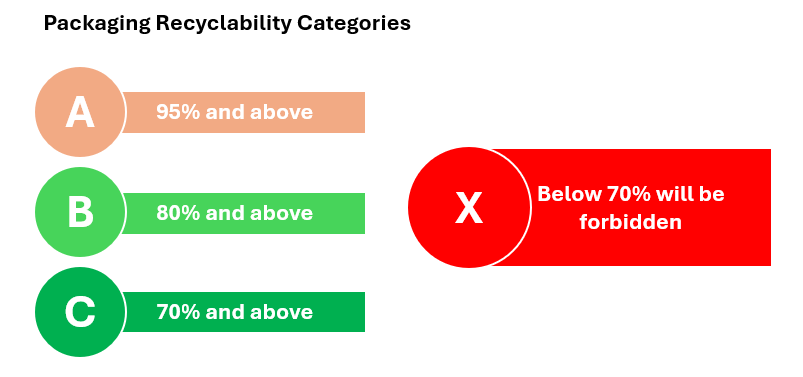
All packaging placed on the market must be at least 70% recyclable. The recyclability categories are defined as follows:
- Category A – 95% and above
- Category B – 80% and above
- Category C – 70% and above
It is possible that a differentiation of recycling fees for individual categories will be introduced in the future to encourage the placement of highly recyclable packaging on the market. In this way, economic incentives could be created for manufacturers to invest in more environmentally friendly packaging.
Minimum recycled content share
New rules set a minimum share of recycled material in new packaging. This step aims to reduce the consumption of primary raw materials and support a closed loop for packaging materials. For example, by 2030, plastic bottles will have to contain at least 30% recycled material. This share may increase further in the future, depending on technological progress in the field of plastics recycling.
Packaging minimisation
The measures include an obligation to limit excessive packaging, which will help prevent the waste of raw materials and reduce the amount of waste. Key measures in this area include:
- Transport packaging must not have more than 50% empty space.
- Consumer packaging should eliminate excessive filler material.
- Reducing the weight and volume of packaging without negatively impacting the product’s protective properties.
Packaging minimisation is important not only from an environmental perspective but also from an economic one – less material means lower production and transport costs.
Packaging reusability and targets
The new legislation introduces obligations for businesses regarding reusable packaging in order to increase its market share. Key measures include:
- Transport packaging for domestic logistics must be 100% reusable.
- A minimum 10% share of reusable packaging will be set for alcoholic and non-alcoholic beverage packaging.
- Support for deposit-return schemes and take-back systems, thereby reducing their environmental footprint.
- Large stores with an area exceeding 400 m² will be required to allocate at least 10% of their floor space to refill stations, where customers can refill food and non-food products into their own containers. This initiative promotes a culture of sustainability and limits the consumption of single-use packaging.
Total recycling targets
The legislation defines gradually increasing targets for the recycling of packaging materials, aiming to ensure their efficient processing and reduce environmental impact:
- By 2030, at least 75% of all packaging must be recycled.
- Specific targets for individual materials: plastics 55%, paper and cardboard 85%, glass 80%.
- Increasing capacities for processing recyclable materials at a national level.
Labelling and waste reduction
- A uniform packaging labelling system will be introduced, providing clear information on material composition and sorting methods.
- The objective is a progressive reduction in packaging waste per capita compared to 2018 levels, with a specific focus on commercial and industrial packaging.
- Support for the research and development of new materials that are more easily recyclable and less harmful to the environment.
Bans on certain packaging types/formats
The PPWR regulation also focuses on bans on the use of single-use plastic packaging for food and beverages consumed within the HORECA sector (hotels, restaurants, and cafes), as well as single-use packaging for condiments, sauces, sweeteners, or coffee creamers.
In the accommodation services sector, the ban will also apply to single-use packaging for cosmetics and toiletries commonly used in hotels.

A ban will also be introduced on single-use plastic packaging for fresh fruit and vegetables weighing less than 1.5 kg. This includes various bags, nets, or small containers – it is expected that numerous exemptions will be applied across individual member states.
Conclusion
Although the share of recycled waste in the EU has increased in recent years, the total amount of packaging waste continues to rise. In 2022, the average EU resident produced 186.5 kg of packaging waste, of which 36 kg consisted of plastic packaging. This means that every EU resident generates approximately half a kilogram of packaging waste per day.
The new PPWR regulation focuses on waste prevention, promoting recycling, and the reuse of packaging, which will contribute to more sustainable packaging management across the EU. The measures introduced aim not only to reduce the environmental footprint of packaging but also to encourage innovation in sustainable materials and improve the efficiency of recycling systems within member states. Looking ahead, further tightening of requirements can be expected in order to achieve a circular economy and reduce the impact of plastic waste on nature and public health.